
In my campaign for Maryland State Senate, I emphasized that improving public education required more choice and competition, free market solutions, rather than government control through censorship and monopoly to a dysfunctional and obsolete system more about expanding a bloated government employment than the education of students.
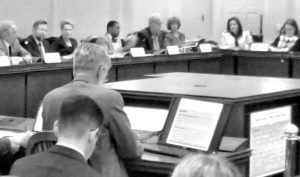
On November 29, 2018, the Kirwan Commission to improve “innovation and excellence” in Maryland met to hear public testimony concerning what recommendations to give to the Maryland General Assembly in this matter. Speaking for my organizations, International Montessori Society and Trust Tutoring, I urged the commission to support more choice and competition as the best means to assure accountability, quality, and value in Maryland public education. From personal experience, I argued that there was no higher level of accountability possible than that of the child’s parents choosing his education, rather than a remote government establishment, such as through the outdated and dysfunctional public school system. In my written remarks, I laid out 8 different specific ways this could be done as a practical matter, including the repeal of compulsory attendance laws.
I also testified that Maryland education has been highly defective and degraded in value through its long pattern of censorship and monopoly control in the field. I urged the commission to recommend putting on the breaks to this pattern, to reduce the mismanagement and corruption brought about by bloated government employment and excessively high salaries in public education. I also pointed to the burden to parents and ordinary citizens alike caused by excessively high taxes make any choice of non-government education virtually impossible for many.
When the final Kirwan report comes out, their recommendations will surely be presented to the General Assembly, which will in turn consider their adoption. As a concerned public citizen, I plan to stay active and aware about these issues, which I would have raised strongly as a leading voice for change and improvement in education, had I gained a seat in the Maryland State Senate. Citizens are encouraged to stay aware of developments in education, especially funding issues, as they come forward for votes and public hearings in the Maryland General Assembly.
Here is a summary of comments I made to the Kirwan Commission in my written testimony of November 29, 2018:
Commission on Innovation and Excellence in Education
c/o Office of Policy Analysis
Department of Legislative Services
Legislative Services Building
90 State Circle
Annapolis, MD 21401
Dear Dr. Kirwan and Commission Members,
I’m writing to offer recommendations for your report on behalf of innovation and excellence in education. As director and founder of the International Montessori Society (IMS) in Maryland since 1979, I have a long experience with Maryland education, especially as related to its regulation and involvement in the non-government sector. Besides my leadership of IMS, I am also founder and director of an in-home tutoring program, Trust Tutoring, which has been operating in its present form in Maryland since 1992. In both positions, I have observed and experienced first-hand the operation of education in Maryland, which has afforded much opportunity to study its various problems and how to improve quality and value in this area.
The main problem with Maryland education has been its heavy reliance on top-down, centralized government control through such means as academic content censorship and monopoly operation in the field. Needed instead is accountability through the normal functioning of personal choice and competition at the grassroots level. While public funding requires government oversight and accountability, parents, educators and local jurisdictions need more space to assume their own direct accountability for quality results, to learn through their own experience how to change and adjust educational activity to meet the needs of their own particular situation. With this greater freedom naturally comes innovation and personal responsibility for quality and value, which will ultimately assure excellence in Maryland education for the benefit of all. My recommendations reflect this conviction as related to various specific issues.
Funding and expanding pre-k education
Rather than expanding the operation of direct government programs, such as through the current public school system, use the existing network of successful pre-k programs that function around the state by allowing parents to freely choose what best suits their own need and situation. In this way, parents assume a leading role and responsibility in the education of their children, which is the best assurance of quality in every situation. Where parents are unable to pay, the government could qualify parents for welfare assistance based on availability of taxpayer funds, and specific level of poverty. In dysfunctional family circumstances, employ the greater involvement of social services in making these choices, such as through the operation of local foster care agencies.
Repeal Compulsory School attendance law
Current compulsory school laws threaten parents with punishment for failure to send their children to some type of government approved schooling. Since government holds a monopoly over public education, parents are forced to attend only the local public school, or some equivalent non-government alternative which it controls through licensing approval or special interest accommodation. Repealing compulsory school attendance would free parents from this intimidating power and control of government, and force the public schools to compete for parents to enroll their child with them.
Uniform Funding of Public Schools
At present, the funding of public schools is conducted through a complex combination of specific state level allocations and sharing taxes at the state and local level. In this situation, funding is considerably political, with each jurisdiction fighting for its own issues with the General Assembly from one year to the next. Recommended is a uniform per-pupil funding for ALL jurisdictions through an objective mathematical formula, with some percentage differential to adjust for local funding effort and available tax base. Within this system, each jurisdiction should have freedom to experiment with its own manner of spending, with the caveat of state level accountability to prevent waste, fraud and abuse.
Financial Accountability in Public Education
Support the Governor’s commission on accountability over all public schools in the state. Such a commission should be empowered to investigate fraud, interview educational personnel in confidence, and inspect documents, as well as refer cases for prosecution or other action where deemed suitable.
De-centralize Public School operation and control
Empower each local jurisdiction with freedom to experiment with its own delivery of curriculum and format. Reduce state mandates for programmatic content and approach, so that uniform testing is the main essential means of quality control of content at the state level. Coupled with other choice and competition enhancements at the state level, such as ease of charter school formation and operation, objective per-pupil funding formula, and greater availability of options in the free market economy, individual parents will have sufficient practical means to find better educational options when the existing public school system fails to deliver adequate quality.
Expand freedom for non-government education
At present, the government imposes burdensome, restrictive, and unfair licensing control over the operation of non-government education. It is recommended, therefore, to lift these unnecessary burdens, such as special interest benefits to one group over another, and the censorship of academic content. In this way, parents have a wider field of options outside the public school system, and this creates competition for better quality and value among all schools, both public and private.
Expand choice in charter school operation
In Maryland, forming and operating charter schools is especially difficult due to such factors as hiring staff that is confined to state-approved certification only. It is recommended to change this, for example, by using a less restrictive condition for hiring, such as “skilled and competent” rather than state certificate. In addition, charter schools should be able to more easily obtain approval to operate, since a local board of education may resist approval for political reasons, such as fear of “competition.”
More simple, objective state testing
Current state testing is so detailed and time-consuming that it interferes with classroom instruction. It is recommended to replace the current testing with a simpler, more objective format, based on essential basic skills only. Whatever further testing for quality and curriculum content should be left to the discretion and judgment of the local jurisdiction.
Reduce Excessive Administrative Costs and Salaries
Maryland has a serious problem of bloated administrative personnel and high salary levels than misallocate taxpayer funds away from actual instruction needs and basic facility maintenance. In Maryland higher education, for example, excessive salary levels are common, approaching 1 million dollars per year, even while student tuition and other costs to students grows higher all the time. It is recommended to cap all salary levels of education personnel, such as no greater than the highest paid public officer in the jurisdiction.
Finally, let me thank you for this opportunity to offer these recommendations to consider in preparing the Commission’s final report. Please contact me if you have questions or wish further discussion on these matters.
Sincerely,
Lee Havis
Director, International Montessori Society
Director, Trust Tutoring