
The underlying cause of all problems in the state of Maryland comes down to the destructive, failing education of children, which has such a disastrous effect on their future progress and success as productive members of society. So, as a candidate for the Maryland State Senate, my campaign is addressing this fundamental issue by proposing a total transformation of the whole operation of state public education.
The problem of Maryland public education can’t be solved within its current operational framework. It’s just too full of costly, inefficient and wasteful in spending, due to its centralized, political curriculum control, and a total lack of accountability for meaningful results of academic achievement and successful student outcomes.
So how has the Democrat controlled Maryland General Assembly proposed to solve this problem? In fact, it’s been just to throw more money at it, focusing on social engineering, such as “gender identify and sex orientation” curriculum in the elementary school curriculum, rather than the basic academics of reading and math.
MORE MONEY is not the answer, since the state of Maryland already has one of the highest per-pupil spending levels in the country, while other states, with much lower spending achieve much better scores of academic achievement. For example, the current public education budget gobbles up a whopping 40% of the whole state budget, while the Democrat majority General Assembly keeps funding it more, with same or poorer results than before. Recently, Fox News 5 in Baltimore (Chris Papst, March 2025) reported that in 2017, Maryland spent $7.7 billion tax dollars on K-12 education. And by 2024, that number had spiked to $11.4 billion – a 48% increase. So what is there to show for all that increased spending?
Data from the National Assessment of Educational Progress (NEAP), a program that measures student achievement in various subjects across the United States, tells the story in its recent report at NationalReportCard.gov (nces.ed.gov). In that report, it shows that since 2021, despite massive new spending for education in the state, Maryland test scores in 4th grade Reading have not significantly differed from the national average, which in 2024 showed that only 31% of students were proficient or advanced in that subject. In fact, before 2021, with lower levels of funding, Maryland NEAP Reading scores were at times actually much higher than the national average. At the same time, NEAP 8th grade Math scores for Maryland students have actually shown significantly below level outcomes in 2022 and 2024.
Compare Maryland spending for education with other states. NEA (National Education Association) reports that Maryland has $22,000 per-pupil spending in education, one of the highest levels of spending in the nation. However, states with much lower per-pupil spending have shown significantly better student outcomes. For example, Florida spends only about $15,000 per-pupil on education, and yet consistently scores significantly above the national level in 4th grade Reading. And Idaho, with only $13,000 per-pupil funding, the lowest level of funding in the whole nation, consistently scores significantly above the national average in 8th grade Math.
And look at education spending in nearby District of Columbia! Despite the highest per-pupil education spending of the entire nation, at $35,000 per-pupil, student outcome is below the national average score in 4th grade Reading, and almost dead last in 8th grade Math.
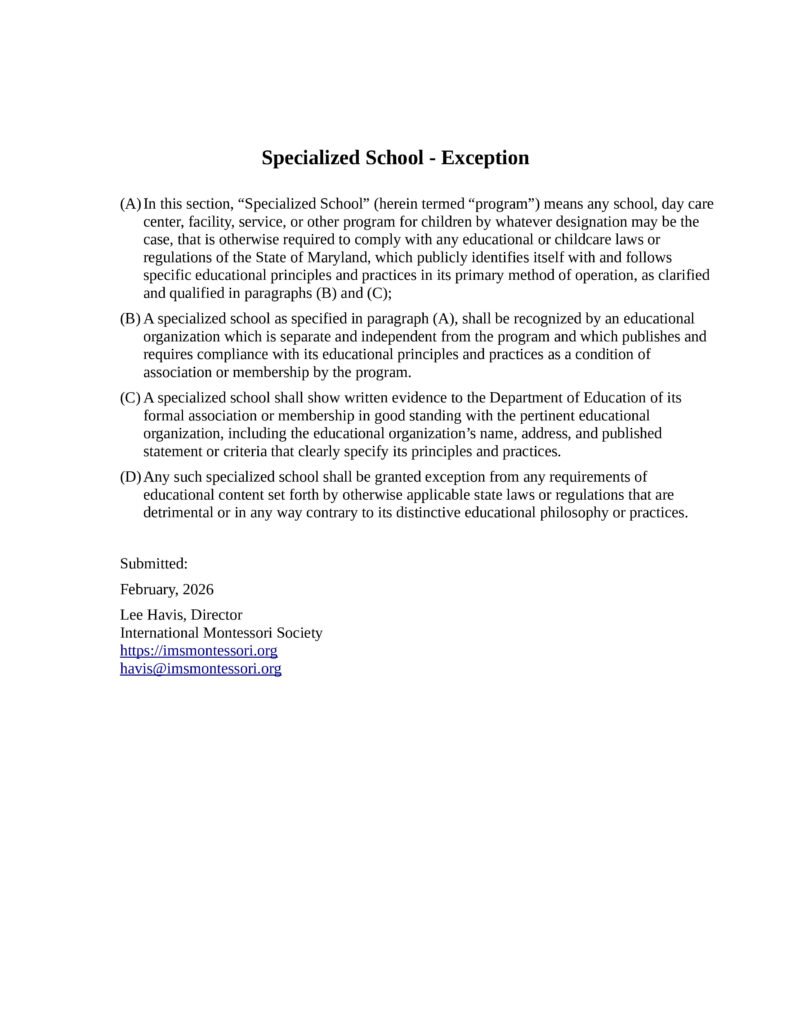
As a long time leader in the field of innovative scientific teaching in the private sector, I know that an ungraded approach of individualized self-directed learning, with teachers trained in this scientific approach, will be much better results than the current state controlled curriculum. But since this type of scientific teaching would not be agreeable to all, the best way to solve the problem of the present failing public system is to return the whole field of education to the free market economy. This would establish real freedom of choice, competition and accountability for each parent, student, school, and educator to work out on their own.
This type of transformation of the public education system must be done in steps that will ultimately restore the original purpose of education to help children acquire the basic skills and confidence to function as responsible, self-reliant citizens in a truly free, self-governing society.
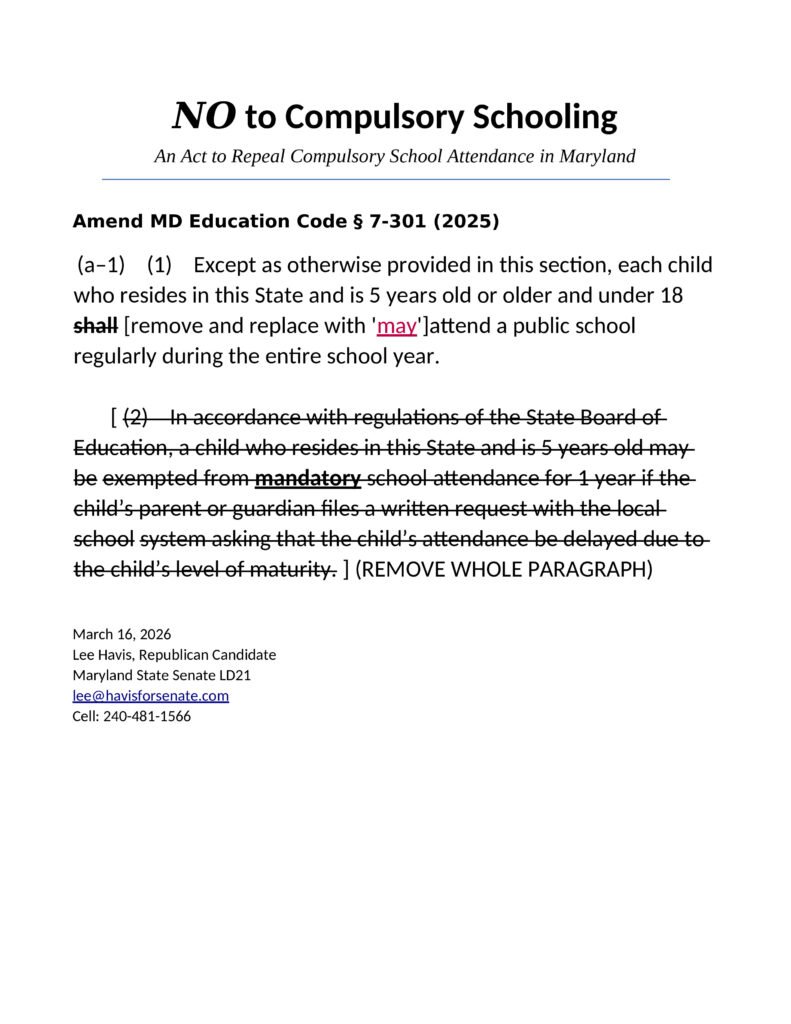
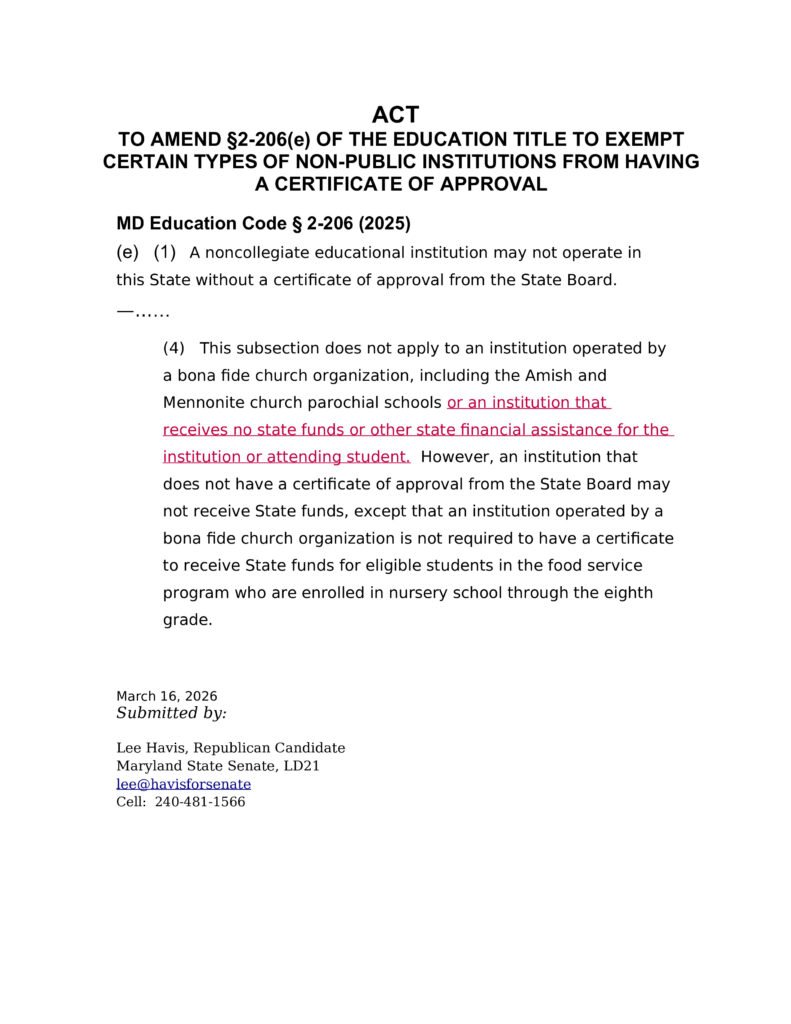
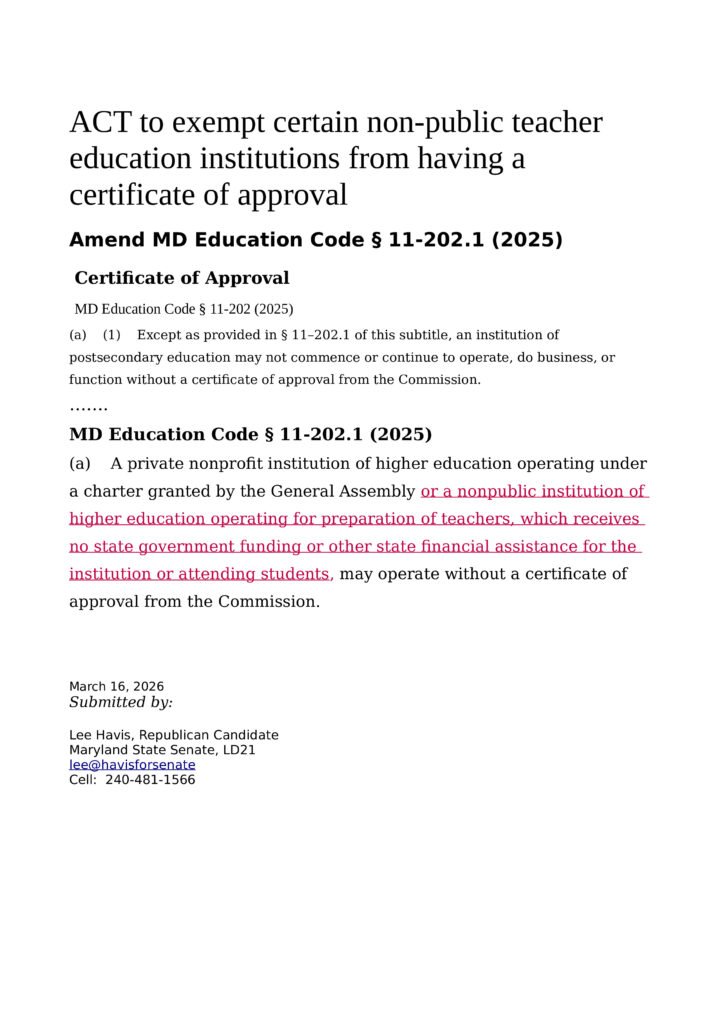
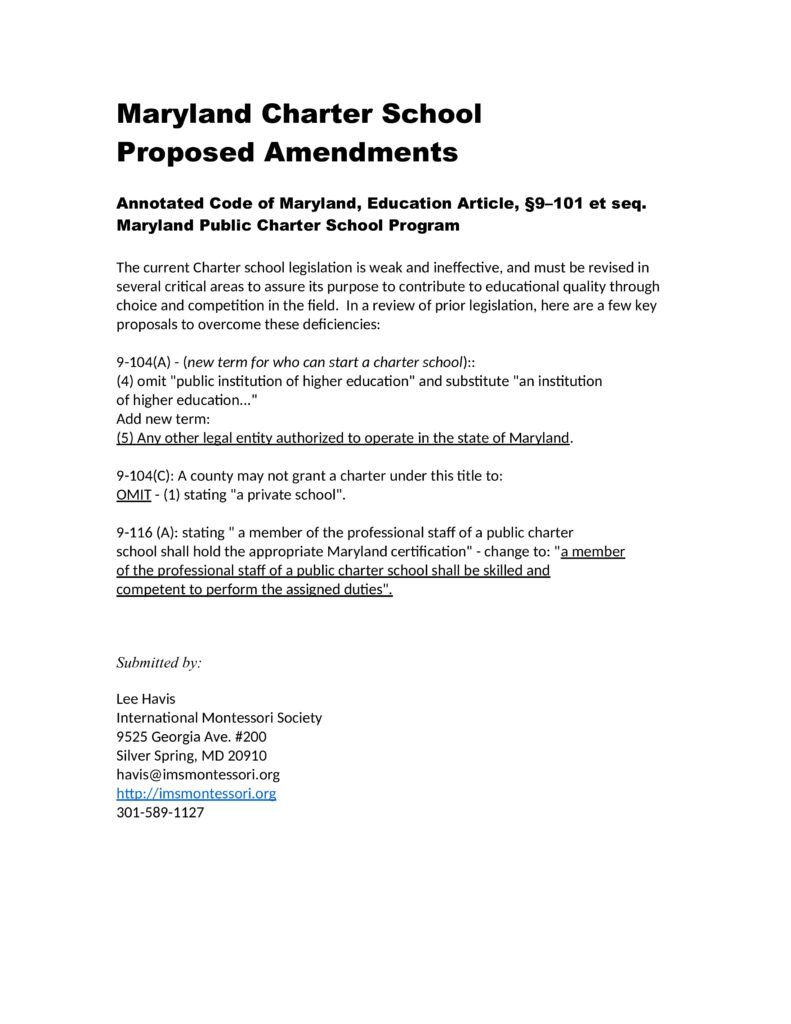
In the Maryland General Assembly, I would therefore introduce and work for passage of specific legislation to transform Maryland education in this way, such as by proposing we repeal the law for compulsory school attendance, and providing parents with real choice through a variety of alternatives to the conventional public school placement. For example, lift burdensome restrictions on tutoring, home school, and other forms of private education. In addition, revise the charter school legislation to give more control to parents with greater latitude for the hiring of staff. These specific legislative proposals are set forth here below.
Freedom from government regulation for certain private schools
Freedom from government regulation for certain private teacher education programs
Exception from government education controls for certain specialized schools
More freedom for Maryland charter schools
Repeal Compulsory School Attendance